
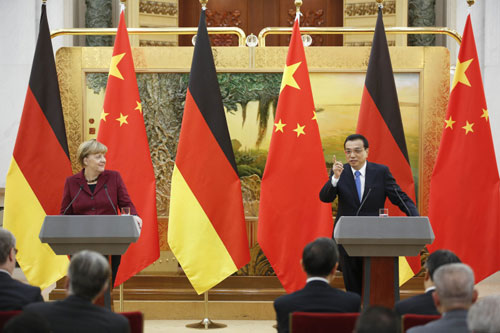
On the morning of October 29, 2015, Premier Li Keqiang and Chancellor Angela Merkel of Germany jointly met the press at the Great Hall of the People.
Li Keqiang briefed on the results of talks between Angela Merkel and him. He expressed that Chancellor Angela Merkel and I held friendly, in-depth, candid and efficient talks, reaching numerous consensus and achievements in topics including forging a "comprehensively upgraded version" of China-Germany cooperation, jointly coping with global challenges and maintaining global and regional peace and stability. As a pacemaker of China-EU cooperation, China-Germany cooperation has reached a fairly high level in terms of scope and depth. Both sides agreed to maintain close high-level exchanges, improve construction of mechanisms at all levels and in various fields, and enhance understanding and accumulate mutual trust through dialogues and cooperation. The two sides agreed that the 4th round of China-Germany intergovernmental consultations will be held in China next year in due course, and China will invite Chancellor Angela Merkel to co-chair the consultations at that time. Both sides will also launch China-Germany consultations on Internet affairs and promote the construction of an open and secure cyberspace, as well as strengthen the docking of development strategies and coordination of macroeconomic policies. The two sides will advance the collaboration between the strategy of "Made in China 2025" with "Industry 4.0" strategy of Germany, push the synergy of "Made in China" and "Made in Germany" and expand strategic cooperation in emerging industries; accelerate the negotiations of China-EU Investment Agreement in the model of a negative list plus pre-establishment national treatment and launch a feasibility study on China-EU Free Trade Area (FTA) as soon as possible; and jointly develop third-party markets. The two sides support multilateral trade systems and hold that both China and the EU should fulfill their respective commitments upon China's entry into the World Trade Organization (WTO).
Li Keqiang pointed out that China is implementing the innovation-driven development strategy and advocating mass entrepreneurship and innovation to stimulate market vitality and people's creativity. Both China and Germany should look to the future, take full advantages of the huge potential of China's economy, especially in the development of China's central and western regions, enhance cooperation in innovation development and construction of new type of urbanization, drive entrepreneurship, promote upgrading and fuel growth by innovation, and create new highlights and growth points in bilateral relations.
Angela Merkel noted that Germany has full confidence in the prospects of China's economy. China's promotion of economic transformation and sustainable development provide new opportunities for bilateral cooperation. The German side stands ready to dovetail "Industry 4.0" strategy of Germany with the strategy of "Made in China 2025", welcomes Chinese enterprises to invest in Germany to promote two-way investment and is willing to take an active part in the construction of the Asian Infrastructure Investment Bank (AIIB). Germany supports the RMB's inclusion into the Special Drawing Rights (SDR) basket of the International Monetary Fund (IMF) and supports China to be a member of the European Bank for Reconstruction and Development (EBRD). The German side hopes that the EU-China Investment Agreement will be signed at an early date so that the feasibility study on EU-China FTA can be carried out, and is pleased to see the EU's positive progress in the economic status in Chinese market. Germany appreciates China's constructive role in the preparations for the UN Climate Change Conference in Paris and the efforts to cope with climate change. Germany also looks forward to the convening of the next round of consultations between the two governments.
The Premier and the Chancellor also answered questions from journalists on China's economic situation, China-Germany innovation cooperation, the Syrian issue, the refugee crisis in Europe and others.