
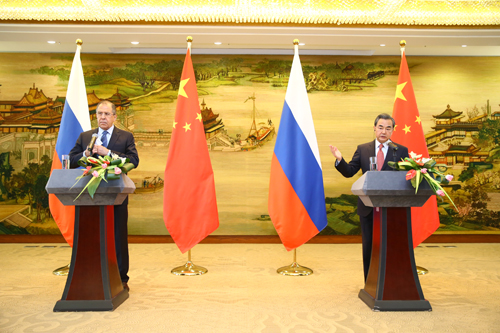
On April 29, 2016, when jointly meeting the press with visiting Foreign Minister Sergey Lavrov of Russia after their talks, Foreign Minister Wang Yi stated his views on China-Russia practical cooperation.
Wang Yi expressed that China-Russia practical cooperation in all fields serves as powerful impetus for the development of bilateral relations. The two Foreign Ministers agreed that despite the influences of some external factors in recent years, China-Russia practical cooperation enjoys high complementarity and unique political advantages. Both sides are confident and capable of tackling current challenges and problems and opening up broader prospects for cooperation.
Wang Yi stated that at present, China has become Russia's largest trading partner and an important source of foreign investment, while Russia is one of China's major suppliers of energy resources and electromechanical and high-tech products. The drop in bilateral trade volume since last year mainly attributes to the sheer fall in prices of major international commodities. The scale and quality of China-Russia trade did not shrink, but increased instead. For instance, last year China imported more than 40 million tons of crude oil from Russia, with a 28 percent year-on-year growth, while its import of electromechanical and high-tech products from Russia grew by 32.1 percent and 34.2 percent respectively compared with that during the same period of the previous year. New areas of bilateral cooperation, such as cross-border e-commerce, also enjoy rapid expansion. Russia has become the second largest export destination of China's cross-border e-commerce.
Wang Yi stated that in the next stage, as both heads of state have agreed, China and Russia will take the docking of both development strategies as well as the construction of the Belt and Road and the Eurasian Economic Union as opportunities to vigorously promote innovation and practical cooperation in all areas. First, accelerate the upstream-downstream integration in energy exploitation and extend cooperative industrial chain for further-interwoven interests and enduring cooperation between the two countries. Second, carry out innovation collaboration. Both countries should actively discuss on the establishment of a dialogue platform for China-Russia innovation cooperation and make innovation a stronger driving force for bilateral practical cooperation. Third, expand cooperation in production capacity and co-production, such as the joint-development of long-range and wide-body jets and heavy-duty helicopters and the co-construction of Moscow-Kazan high-speed railway. These projects will boost both countries' comprehensive strength and international competitiveness. Fourth, expand local-level cooperation with focus on cooperation between Northeast China and Russia's Far East as well as the cooperation between the Middle and Upper Reaches of the Yangtze River of China and the Volga Federal District of Russia.