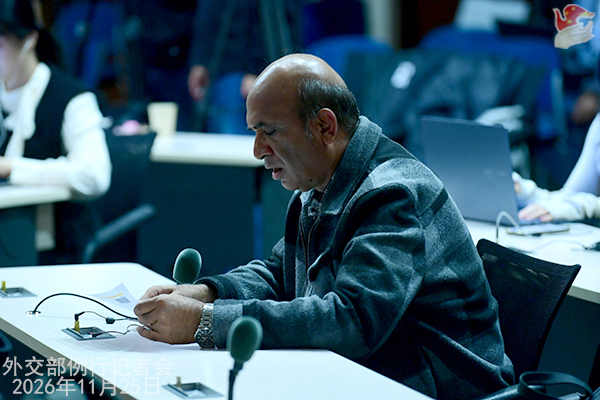
Associated Press of Pakistan: Today, China has successfully launched the Shenzhou-24 crewed spacecraft, with a Pakistani astronaut making history as the first foreign guest to participate in the mission from the Jiuquan Satellite Launch Center. How does the Chinese foreign ministry view the significance of this milestone in China’s space program, and what opportunities does it present for further strengthening space cooperation between Pakistan and China, particularly in areas such as astronaut training and joint space exploration?
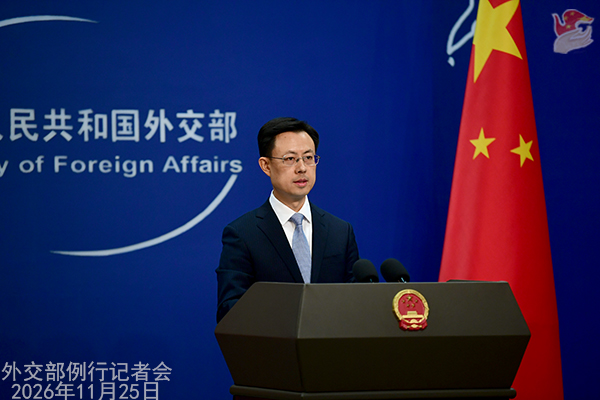
Guo Jiakun: Today, amid high expectation of our two peoples, the Chinese and Pakistani astronauts embarked on the journey to China’s Tiangong space station for historic space technology cooperation. It is the first time for China’s space station to welcome a foreign astronaut, marking a new milestone in international cooperation on China’s manned space program.
As President Xi Jinping noted in his congratulatory message to Pakistani President Zardari, the joint spaceflight mission of Chinese and Pakistani astronauts epitomizes the profound friendship between our two countries and marks another important outcome of the bilateral cooperation. China’s space station is a space station of peace, friendship and cooperation. China will work with Pakistan and other countries to hold high the banner of peaceful use of outer space, deepen international cooperation on space programs, improve global space governance, and ensure that the outcomes of outer space exploration benefit all humanity.
Exploring the space is our shared aspiration. China’s space station is not only a home in space for Chinese astronauts, but also a pilot platform for global scientific research. The joint spaceflight has expanded and injected fresh impetus into China-Pakistan all-weather strategic cooperative partnership. We stand ready to work with more countries willing to embrace cooperation to explore the vast space together.
Global Times: The U.S. State Department issued a statement welcoming the joint bid by Chile and Belgium to host the Secretariat of the Biodiversity Beyond National Jurisdiction (BBNJ) Agreement. Does China have any comment on that?
Guo Jiakun: The United State, neither a state party to the United Nations Convention on the Law of the Sea nor to the BBNJ Agreement, has no say on the selection of the BBNJ Secretariat seat. We call on all parties to stay vigilant against attempts to politicize the bidding and create confrontation in the process.
China has made clear its position on the Belgium-Chile proposal. This joint candidature is problematic in at least six aspects, namely, it contravenes the stipulations of the BBNJ Agreement, procedural justice, established international practice, equitable geographical distribution, fair competition and the original commitment. Let me stress once again that according to the BBNJ Agreement, the seat of the Secretariat, the specific modalities for the operation of the Clearing-House Mechanism (CHM), including its installation, as well as where the subsidiary bodies hold their meetings shall all be determined by the Conference of the Parties, and the CHM shall be managed by the Secretariat. These are the consensus as well as rights and responsibilities of all Parties to the Agreement, which no country has the right or is in any position to violate. No one shall trade under the table what should be collectively determined by all Parties, let alone coerce or hijack other Parties into accepting their proposal.
As one of the first signatories and Parties to the Agreement and the largest assessed-contributor to its budget, China stands ready to work with the international community to uphold the original purpose of the Agreement and keep the selection of the Secretariat seat proceeding in the right direction, so that the BBNJ Agreement can truly serve the shared interests of humanity.
Bloomberg: The U.S. is set to announce tariffs on goods from China and some other countries. The additional tariffs won’t lead to an overall rate that exceeds the agreed-upon levels, which were reached in individual trade talks earlier. Would China like to comment on these possible levies coming?
Guo Jiakun: Our position on handling China-U.S. economic and trade issues is consistent and clear. Tariff wars and trade wars serve no one’s interests. Relevant issues should be resolved through consultation on the basis of equality, mutual respect and mutual benefit. The so-called issue of “industrial overcapacity” does not really exist and should not be used as a pretext for political manipulation. China and the U.S. need to jointly deliver on the important common understandings between the two presidents, and maintain the steady growth momentum of China-U.S. economic and trade ties.
Reuters: Australian Prime Minister Anthony Albanese said today that a new treaty will strengthen Australia’s security partnership with the Solomon Islands. Has the Solomon Islands terminated its security pact with China? How will the new treaty affect China’s relations with the Solomon Islands?
Guo Jiakun: We have made clear our position yesterday. The international community should help Pacific island countries realize sustainable development. At the same time, in developing relations with Pacific island countries, all countries need to respect their independence, put development first, and uphold openness and inclusiveness. Relevant cooperation should not target any third party.
AFP: Thailand is holding talks on pollution from mines in Myanmar at the moment. Some of these mines are run by Chinese companies. Thailand has apparently asked for mining sites to close for six months. Does China support this request from Thailand and has China asked any Chinese companies to stop mine production in Myanmar?
Guo Jiakun: As a friendly neighbor of Thailand and Myanmar, China follows closely the issue of water pollution in the Mekong tributary along the Thailand-Myanmar border. We stand ready to work with Thailand and Myanmar to enhance cooperation on water resources governance, share experience, strengthen capacity, and jointly protect the ecological environment of the Mekong River basin. We hope Thailand and Myanmar will make good use of the joint working group mechanism to conduct field investigations, to which China will send experts and provide technical support.
I would also like to stress that the Chinese government always asks Chinese enterprises overseas to abide by local laws and regulations and opposes any act that harms the ecological environment. The issue of water pollution may involve multiple factors, including geological conditions, climate change and human activities. We should identify the root causes and take targeted measures in a science-based, professional and objective spirit, and refrain from jumping to conclusions or making hasty judgments.