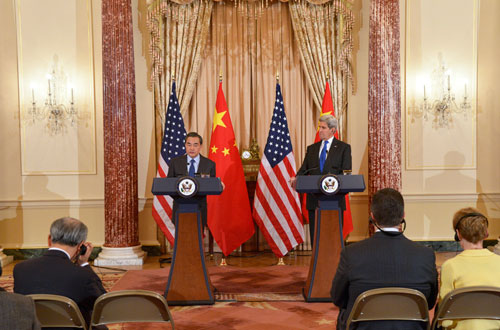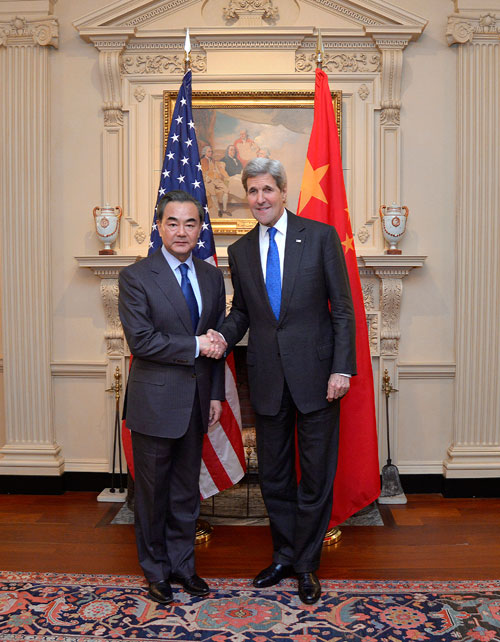
On February 23, 2016, Foreign Minister Wang Yi, who was paying an official visit to the US, held talks with Secretary of State John Kerry of the US in Washington D.C.
Wang Yi expressed that my three meetings with Secretary of State John Kerry within one month indicate that the two sides attach great importance to China-US relations and both hope to develop well the vital bilateral relations. International media often focus on some of the problems existing between China and the US. However, in fact the common interests between the two countries are much greater than disagreements and the depth and breadth of bilateral cooperation are far beyond partial frictions. Talks between the two sides touched not only how to deepen cooperation but also how to manage and control disagreements. The responsibilities of the two Foreign Ministries are to discover problems, face squarely the problems and tackle them with joint efforts, removing obstacles and paving the way for the healthy development of bilateral relations at any time like "scavengers".
Wang Yi stated that this year is a significant year to implement the results of President Xi Jinping's visit to the US. The two sides should adhere to the consensus reached by the two heads of state, maintain and strengthen dialogues and exchanges at the top and other levels, accelerate the negotiation process of China-US Bilateral Investment Treaty (BIT), improve anti-corruption and law enforcement cooperation, further broaden people-to-people and cultural exchanges and local exchanges through carrying out projects like "China-US Tourism Year", and continue expanding bilateral cooperation in broader fields. China supports the US to hold the fourth Nuclear Security Summit in late March and early April in Washington D.C. and welcomes President Barack Obama to attend the G20 Hangzhou Summit in China this September.
Wang Yi pointed out that the Asia-Pacific is the region where China and the US have the most converged common interests. The two sides shoulder important common responsibility for the peace, stability and development of the Asia-Pacific. We should strengthen mutual trust, deepen cooperation, and advance China-US positive interactions in the Asia-Pacific affairs.
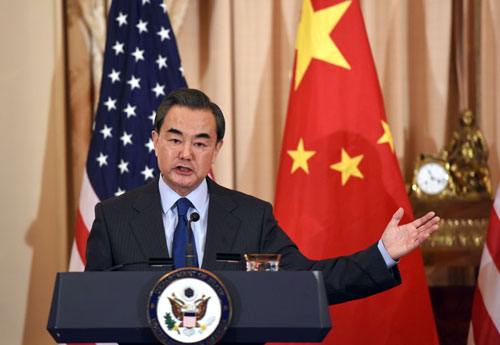
Wang Yi enunciated China's principled stance on the Taiwan issue and the South China Sea issue meanwhile clarified China's solemn attitude that China opposes the US's intention to deploy Terminal High Altitude Area Defense (THAAD) missile defense system in the Republic of Korea (ROK).
John Kerry expressed that US-China relations are essential. The US expects President Xi Jinping to attend the fourth Nuclear Security Summit and supports China in holding the G20 Hangzhou Summit. The successful US-China cooperation in the Iranian nuclear issue, climate change and other issues has exerted positive influences on the world. The US agrees to accelerate the negotiations on China-US BIT and is willing to strengthen cooperation with China in all fields to develop more effective US-China relations. The US hopes to further deepen bilateral cooperation in global issues such as climate change, stands ready to carry out sound interactions with China in the Asia-Pacific, and does not expect the South China Sea issue to be a problem between the US and China. The US sticks to the one-China policy and opposes "Taiwan Independence".
The two sides also exchanged views on international and regional issues such as the Korean Peninsula nuclear issue, the Iranian nuclear issue and the Syrian issue.